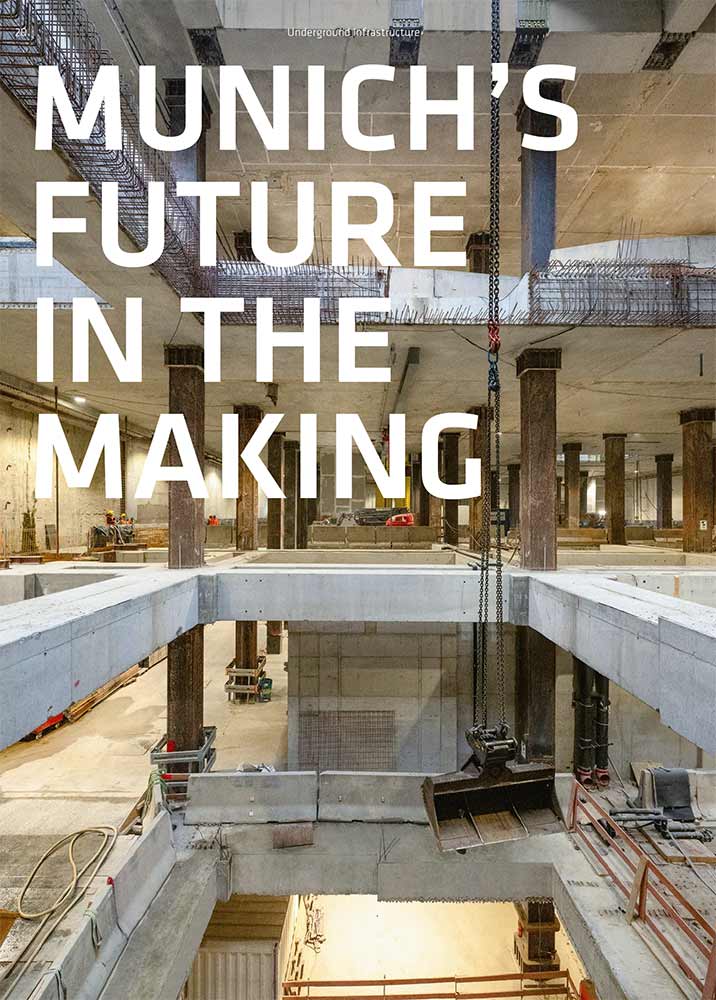
At record depth, the construction of a second main line for the city’s commuter-rail network is underway in downtown Munich; the Marienhof Station. Sika solutions make it possible.
GRAND PLANS
German rail investments have since been boosted by the unprecedented CHF 460 billion infrastructure fund that the German parliament approved in 2025. The expected benefits of the Munich urban rail stations second main line include shorter commuting times and reduced traffic.
The Munich urban rail stations original line or Stammstrecke opened over 50 years ago to improve connections between the city center and outlying suburbs. Today, the line carries well over the volume of people it was designed for due to it relying on a single-track tunnel.
The new 11-kilometer route will run parallel to the original line. A new 7-kilometer double-bore tunnel will let trains zip through in both directions. Two connecting stations will be expanded and Marienhof will be built deep underground. The challenging construction project can be realized thanks to Sika solutions.
Driving profitable growth and creating sustainable shareholder value
Grand plans
Construction of the second main line is one of the largest infrastructure projects in Germany.
Designed for a modern city
The new 11-kilometer route will run parallel to the original main line and allow more passengers to reach the city center.
URBAN REALITIES
At over 40 meters underground, Marienhof Station is the deepest urban rail station in the country sitting under a bustling city center with medieval roots. Marienhof’s platforms, tunnels, and connecting passages must all steer clear of historic landmarks and avoid putting them at risk.
Project teams need to navigate the dense network of pipes, cables, and equipment that deliver energy, water, and other essential services. Additionally, the extreme earth- and groundwater pressure has driven every engineering and construction-related decision to date.
120
year lifespan
45+
meters deep
7
kilometer double-bore tunnel
DEEP DETERMINATION
“Five years before excavation, we started spending a lot of time with key project partners to find solutions to keep the water out and the structure permanently stable. Yes, we started early, but with this kind of project, you don’t want to be problem-solving too late.”
Marco Bloch
Product Engineer for Building and Basement Waterproofing at Sika Germany
If each colossal wall, ceiling panel, and reinforcement column needed to be robust and watertight, so did every millimeter of concrete in between. These transitional areas would be even more crucial to protect given the top-down construction method.


Sika partners include project owner Deutsche Bahn, building consortium ARGE Marienhof, engineering firm Schiessl-Gehlen Sodeikat, and, waterproofing applicator and civil engineering specialists August Reiners Bauunternehmung GmbH.
Ingo Lehmberg, Head of the department for building waterproofing of the August Reiners Bauunternehmung GmbH, credits the achievements to teamwork and frequent site visits. “Developing and implementing innovative technical solutions has been a huge experience, but being part of a team that is breaking new ground has been immensely inspiring and strengthened our partnership.”
3 years
Time it took to test and certify the tailored waterproofing system
5 years
How long Sika provided technical support before the start of construction
CHF 10.1 billion
Overall investment in the second main line project
Delving deep
Marienhof Station is Germany's deepest construction site.
Setting the standard
Sika has not only delivered a customized waterproofing system, but also set the standard for the entire second main line project.
MORE MOMENTUM
Teams are now sealing the station’s enormous base slab, followed by waterproofing before the finer interior work begins. Meanwhile, compressed air tunneling continues with the aim of linking the new station to another metro station nearby.
Each milestone now brings the city closer to its goals, making for a more efficient travel experience to central Munich possible.

Driving profitable growth and creating sustainable shareholder value